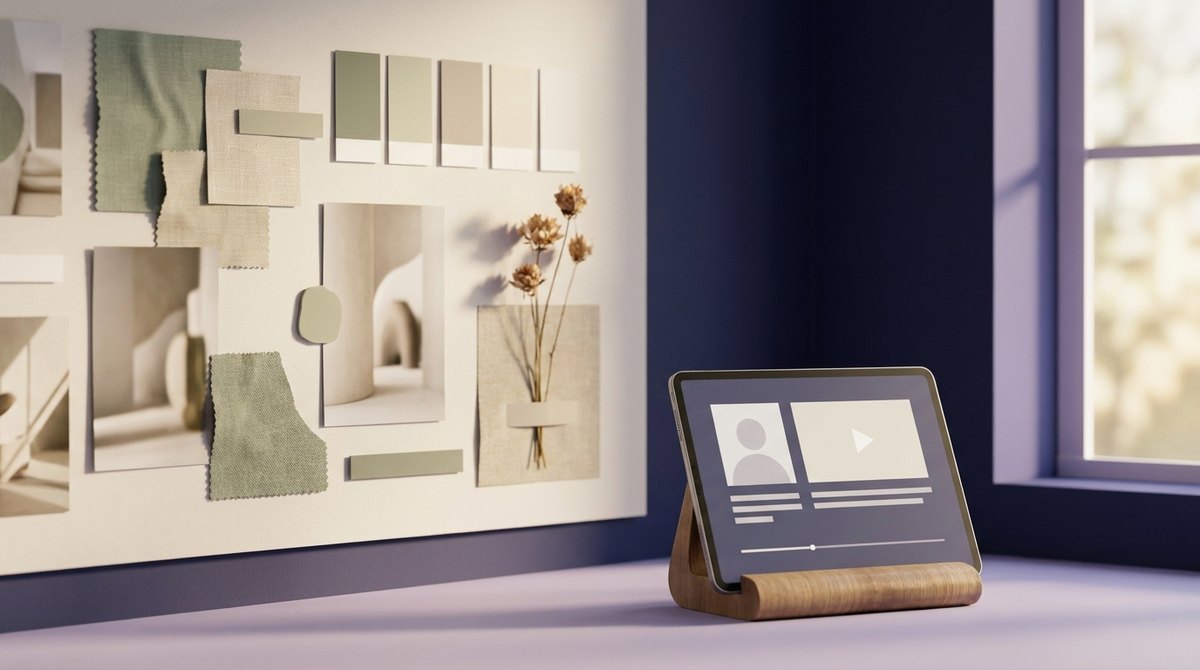
The hardest part of building a mood board isn't finding images. It's knowing what to search for. "Something cosy but not cluttered" doesn't get you far in a search box. The people who are good at this have a vocabulary for it — and a lot of them say it out loud on YouTube.
Room makeovers, desk setup tours, photographers explaining their edits, set designers, colourists: they all describe what they're doing in precise words. A transcript turns those words into a list you can search.
Step 1: pick the right videos
Look for videos where someone explains visual choices rather than just showing them: design breakdowns, "how I edit my photos" tutorials, studio and desk tours, film colour-grading walkthroughs, architecture channels. The more they talk about why, the richer the transcript.
Step 2: get the transcript
Paste the link into Transcript.you and copy the full text. If you've never done it before, this one-minute guide walks through it.
Step 3: harvest the vocabulary
Read through, or search the transcript, and pull out four kinds of words:
- Colours, named precisely. Not "green" but sage, olive, moss, forest, mint.
- Materials and textures. Linen, brushed steel, terrazzo, film grain, frosted glass.
- Light. Golden hour, overcast, backlit, neon, candlelit, harsh midday.
- Named styles. Japandi, brutalist, cottagecore, dark academia, Y2K, vaporwave.
A single 20-minute tour will often give you 30 or 40 usable terms. Paste them into a list.
Step 4: turn words into images
Now you have real search terms. Combine them — a style plus a colour plus a light condition — and search. Start with the collections that already exist: aesthetic wallpapers, cottagecore, dark academia or minimalist. Save what fits to a board.
Step 5: lock the palette
Once you have five or six images that feel right, run the strongest one through the Palette Extractor. That gives you exact hex codes, and suddenly your mood board has a spec: these colours, this light, these materials.
Step 6: generate what doesn't exist yet
Sometimes the exact combination you're after isn't out there. Your harvested vocabulary makes a very good prompt. Feed three or four of the terms — "sage and linen, soft overcast light, Japandi desk" — into the Aesthetic Wallpaper Generator and see what comes back. Precise words give precise results.
Why this works
Specialists describe things more precisely than the rest of us, and the transcript captures that precision word for word. You're borrowing their eye, not their images — which is exactly what a mood board is for.